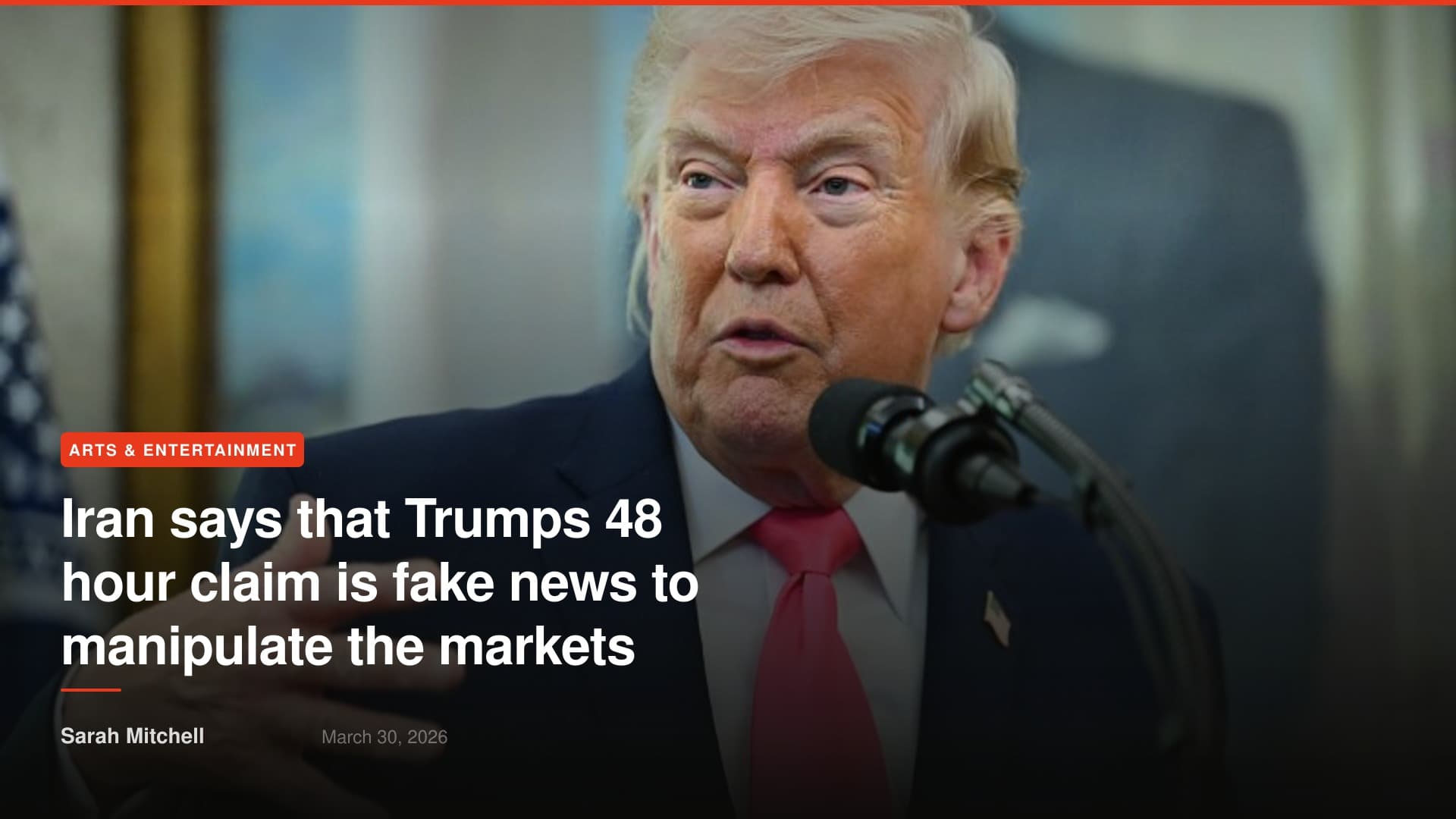
Iran Says That Trump's 48-Hour Claim is Fake News to Manipulate the Markets
In the world of high-stakes politics and market manipulation, truth is often the first casualty. Recent claims by former President Donald Trump have ignited controversy, as Iran accuses him of spreading false information to disrupt global financial markets.
The controversy began with a tweet, a typical channel for Trump's declarations. Trump alleged that within 48 hours, a major geopolitical event involving Iran would unfold. This claim, however, was quickly dismissed by Iranian officials as "fake news" intended to manipulate markets.
Iranian Foreign Ministry spokesperson, Nasser Kanaani, stated, "These baseless claims are a deliberate attempt to create tension and disarray." Kanaani's comments underscore a long-standing rivalry, but also point to a deeper issue: the impact of political rhetoric on global markets.
The Ripple Effect on Markets
While many might dismiss such claims as mere bluster, the financial markets are a different story. The oil market, for instance, is hypersensitive to geopolitical tensions. Within hours of Trump's tweet, crude oil prices saw a noticeable uptick. This kind of volatility is not new. Back in 2020, when tensions between the U.S. and Iran peaked following the assassination of Iranian General Qasem Soleimani, oil prices shot up by nearly 4% overnight.
Even a hint of conflict involving a major oil producer like Iran can send ripple effects through the global economy. Investors, already on edge due to inflation concerns and economic recovery post-COVID-19, react swiftly to any indication of instability. In this case, Iran's claim that Trump's statement was false highlights the fragility of market confidence.
A History of Accusations
This isn't the first time Trump has been accused of using his platform for market manipulation. During his presidency, his tweets often seemed to have direct impacts on stock prices. One notable example was in May 2019, when he announced unexpected tariff increases on Chinese goods. The result? A significant drop in the Dow Jones Industrial Average.
Iran's response to Trump's latest claim taps into this history. The country argues that such statements are not only irresponsible but dangerous, potentially leading to unnecessary economic turmoil and heightened geopolitical tensions.
The Role of Social Media in Modern Geopolitics
The power of social media as a tool for political messaging cannot be overstated. Politicians have increasingly used platforms like Twitter to bypass traditional media and communicate directly with the public. However, this direct line to millions has its drawbacks, especially when misinformation can spread unchecked.
Experts warn that the speed at which information travels on these platforms can lead to hasty reactions both in the public sphere and in the markets. The Securities and Exchange Commission (SEC) has even investigated whether tweets from influential figures could constitute market manipulation.
Looking Forward
The intersection of politics and markets is a complex web of actions and reactions. As the world watches the fallout from Trump's latest claim, there is a broader lesson about the influence of rhetoric on economics. Investors, analysts, and policymakers alike must navigate these waters carefully, distinguishing between noise and reality.
Iran’s accusation of "fake news" speaks to a growing need for accountability in political communications. Whether or not there is any truth to Trump's statement, the incident serves as a reminder of the power—and potential peril—of political discourse in the digital age.
As markets continue to respond to every tweet and statement, the challenge remains: how to maintain stability in a world where information, both true and false, can spread like wildfire across the globe.